Wednesday, September 7, 2011

Books not t-shirts!


There is an online petition whose text reads as follows:

Caltech used to have one of the very best scientific bookstores in the country. Three years ago the Caltech administration, without consulting faculty and students, decided to close it down. Not only the bookstore was important to the faculty in their research and to students for the selling of textbooks and other reference books, but closing down the bookstore in one of the most prestigious universities also sends a terribly wrong signal to the general public and the community. We increasingly live in a time where anti-scientific and anti-intellectual feelings and attitudes are on the rise, and where cultural and intellectual values need the strongest possible endorsement from our centers of scientific excellence. Caltech had a model bookstore that delivered to its community of scholars and to the general public the best of our scientific and technological culture. Despite requests from the faculty and the recommendation of the appointed committee, and despite a promise from the administration that the bookstore would reopen, three years have gone by with no credible sign of its reopening. Its place has been occupied by a travesty of store selling t-shirts and flip-flops. Tell Caltech: Books not t-shirts!

I urge all to add their signatures to this petition who agree with the statement that a world-renown university without a hint of an academic bookstore is a tragic sign of a very worrisome anti-cultural trend that is taking hold of even the places that should stand firm in defense of intellectual values. You can sign the petition here:

Caltech Bookstore Petition

The petition is by no means restricted to members of the Caltech community. It is of direct interest to anyone who values books and values culture and who understands the importance of having a place where one can browse real books and make those precious random serendipitous encounters with unexpected books, encounters that have the power to ignite our creativity, to spark a new direction of thought, unexpectedly.

People these days easily object that one can buy books online and Amazon has better prices. Sure thing it often does, but in order to buy something there you need to know which book you want to buy. The automated generator of recommendations works rather poorly and, especially when it comes to the scientific literature, the possibility to browse the whole text and not a selected handful of pages from the introduction makes a crucial difference. There is more: in a physical bookstore books are arranged on shelves according to some criterion of proximity, which (except for literature, where it is often nothing else than the alphabetical order of the author's name) often is arranged to reflect proximity of content. This is what often produces new mental associations and leads us to new encounters and discoveries, in ways that are impossible to reproduce in online retailers of physical and electronic books.

I can supply from my own experience at scientific research a large collection of examples of ideas that became research papers that were generated by random encounters with books in physical bookstores. This is why, whenever I visit a university or a city anywhere, the very first thing I check out are the bookstores.

The US have seen the recent collapse of the Borders national chain of bookstores. They were quick to blame the economic crisis, the competition of the online stores like Amazon, and the rise of the e-books. That all of these may have contributed is likely true, but they completely failed to see one other major cause: in the last few years the quality of the books available in Borders stores around the country has consistently gone down the drain! What can beat the online competitors is not a mediocre lousy bookstore with more expensive prices, obviously, but a high quality and highly selected bookstore that offers the alternative to the online stores where you have to sort through endless crap to get to find in their catalog the valuable books (which you will never find unless you knew already exactly what you were looking for). This is what Borders utterly failed to comprehend. Not surprisingly, when their stores began to liquidate, the "good quality products" (the few serious science titles, the philosophy and linguistics section, the best picks in the literature, the Oxford series of the Latin and Greek authors, the Criterion Collection DVDs, foreign movies, etc) where gone within hours, while the piles and piles of unsellable crap they filled the rest of their stores with stayed on the shelf up until the moment when they started selling it off at more than 80% discount. I have observed this happening in exactly the same way at several different locations I had the occasion of visiting in different parts of the country.

What this says is clear: the public (at least in the US) is becoming more polarized, like the whole of American society. The few who read are those who are highly educated and want high quality products. Those are the ones a bookstore can live off, because they are those who buy books frequently. The others don't read, period. There is no point having large bookstores filled with crap that can be found in every magazine stand in any regional airport, and which can easily be located online at lower prices, but it does pay to have smaller, very high quality, somewhat more specialized bookstores that aim at a particular kind of public (which exists, at least in the proximity of any university campus, or in any sufficiently urbanized area).

Those who claimed that the book is dead are mistaken. The book plays a fundamental role in culture and learning and in the fostering of our intellectual curiosity and pleasure, as much now as it ever did, but it demands attention and intelligence in the handling of its distribution and selling. Intelligence is exactly what the big chains like Borders lack, and what the bureaucrats that administer universities are also sadly deprived of.

Tuesday, September 6, 2011

Dream and the Underworld

One of the most interesting modern developments of Jungian style psychology can be found in James Hillman's book "The Dream and the Underworld". Starting from the classical psychoanalytic premise of dreams as the bridge between the conscious mind and the depths of the unconscious, Hillman moves away from concepts like Freudian repression or Jungian compensation, towards a different and perhaps more intriguing view, that links the inward journey into the dream world to the soul searching journeys to the Underworld of Homer, Virgil, Dante, and Eliot.


Whether or not dreams really belong to the world of Hades and our experience of them compares to the famous descents to the Underworld of the literary masterpieces of antiquity and of our time, certainly the Underground exists in our minds as a pervasive metaphor of the Underworld and of the unconscious, in compensatory opposition and tense dialog with the conscious mind that lives out in the daylight its above-ground existence.

The Underground is a place of hiding, or resistance, to the point that it has become the very synonym of the Resistance movements that fight against oppressive regimes, starting from the heroic World War II anti-nazi resistance movement across Europe. The Underworld, on the other hand, is not only the realm of the dead. It has also become, in our modern city life, a synonym of the low life, the one that we imagine intent at carrying out shady deals in dark alleys, the living dead of the urban frontier, cast at the margins of society. Exclusion, resistance, opposition, diversity, hunted souls living in hiding, plotting in the darkness: this is all that the world below our world suggests to the imagination.

The Underground is also an image of highly elaborate structures: the subway lines that form the arteries of transportation in our big cities and the intricate texture of pipes and cables that form the nervous system of the information age and the functioning infrastructure of our daily life.


How the emergence of modern society shaped the imagination of the Underground is a theme beautifully analyzed in Rosalind Williams' remarkable book "Notes on the Underground", where the evolution of modern technology goes hand in hand with the evolution of the symbolic significance that our minds project onto the Underworld, while human beings came to penetrate more substantially the space below and transform it with the indelible signature of human presence and intervention. Starting with the dawn of the industrial era and moving on into the information age, the mineshaft, the sewer, the subway, and the more and more extensive urban infrastructure have accompanied the literary worlds created by Verne, Wells, and Hugo, in providing us with the modern imagination of the Underworld.


Yet our dealings with the darkness of caves and the world below the earth surface date as far back as the dawn of humanity and so is, possibly, its connection to dreams and the inner journeys of the mind. The earliest signature of human culture we can trace back into the ages is in the Chauvet Cave in southern France, recently beautifully portrayed in Herzog's documentary "Cave of Forgotten Dreams". In the depth of this cave a human hand of 30,000 years ago drew spectacular images: groups of galloping horses, cave lions, woolly rhinos, bears, bisons. Animal species that no longer are, but whose traces are still preserved, fossilized in the cave rocks, as well as narrated by the hand of the human being who dared to penetrate a dark nest of predatory bears to live a signature of our presence, an act of triumph over fear, or symbolic conquest of animal souls and spirits captured in an immortal narrative.


(paintings of Chauvet Cave from Herzog's "Cave of Forgotten Dreams")

The birth of art, of culture, of human expression could only happen in the darkness of an Underworld populated by monsters. That was the very first descent into the Underworld and the one to which all others, conjured in more modern literate times, ultimately conform to. We are all that 30,000 years old human being who walked into the depths of the underground caves and drew paintings on the walls, and signed that acts with ochre colored palm prints.


(paintings of Chauvet Cave from Herzog's "Cave of Forgotten Dreams")

A hand, a signature, repeated many times on the rocky surface, a cluster of signs, a form of writing, a cry, a name. We are the same human beings who used to walk in those caves so far back in history that the word "history" itself ceases to make sense. We carry those dreams in our minds, in our species' mind. Call it "the collective unconscious" if you wish, or "the collective psyche", as Jung used to. It is part of us and it lives on.

Our "collective conscious" has evolved above the surface of the earth and in the daylight of our conscious minds. It has generated our modern scientific and technological world. Below the surface, we continue to visit caves, confront our monsters, conduct our rituals of artistic creation, and leave our signature there.


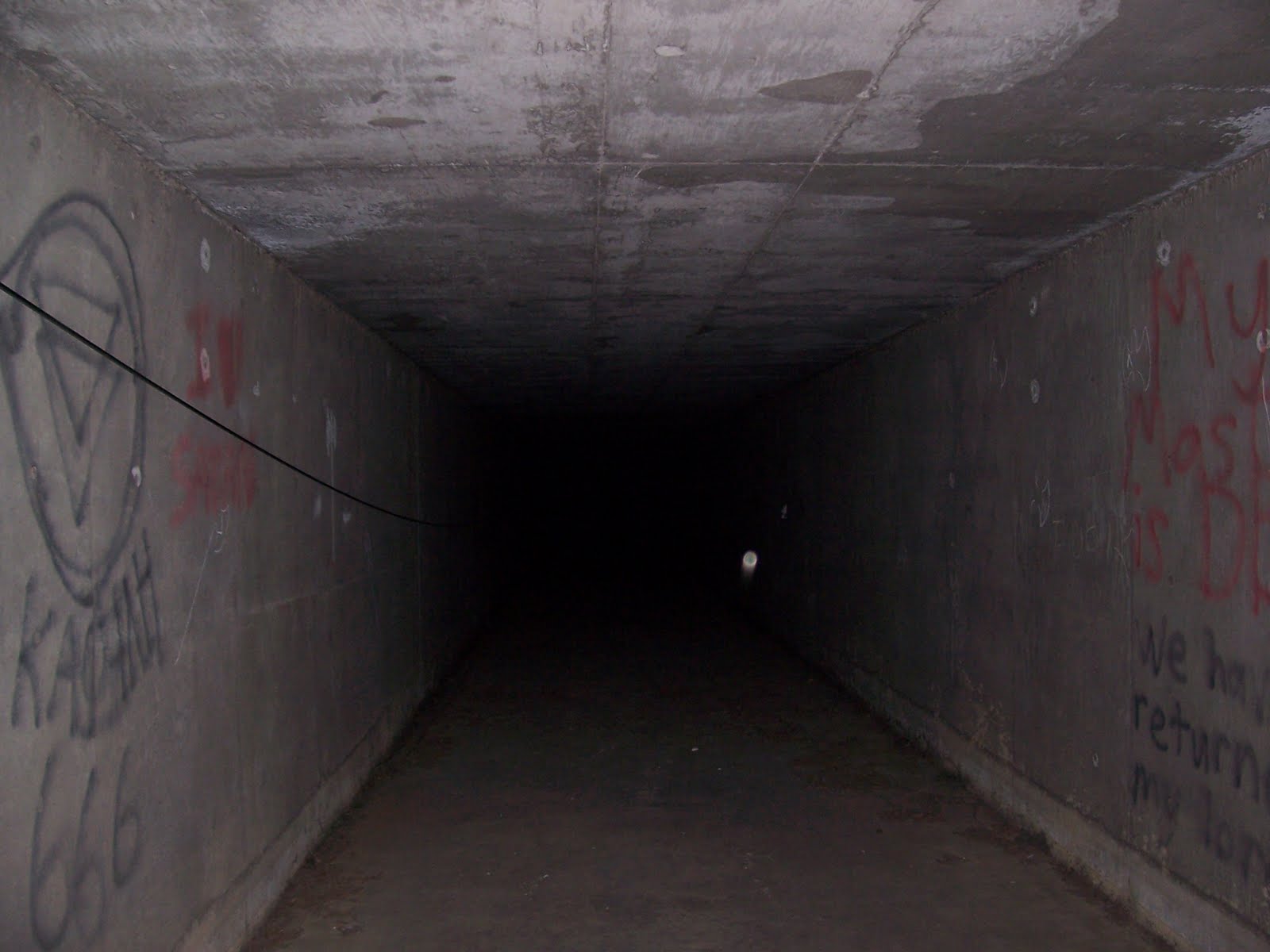
Under the surface of one of the focal points of our solar scientific dream, one of the world's best and most selective universities, powerhouse of scientific research and technological invention, there lies a network of tunnels and steampipes, ventilation systems that feed the labs, a net of infrastructure made of dark labyrinths of concrete and steel, water leaks, abandoned pieces of equipment, discharged office furniture, gaping holes and narrow passages.


Every night, the young men and women, who are going through the harsh and rigorous training of their scientific education in the classrooms and labs of the university above the ground, descend deep beneath the surface. They meet and travel together along the steam tunnels.


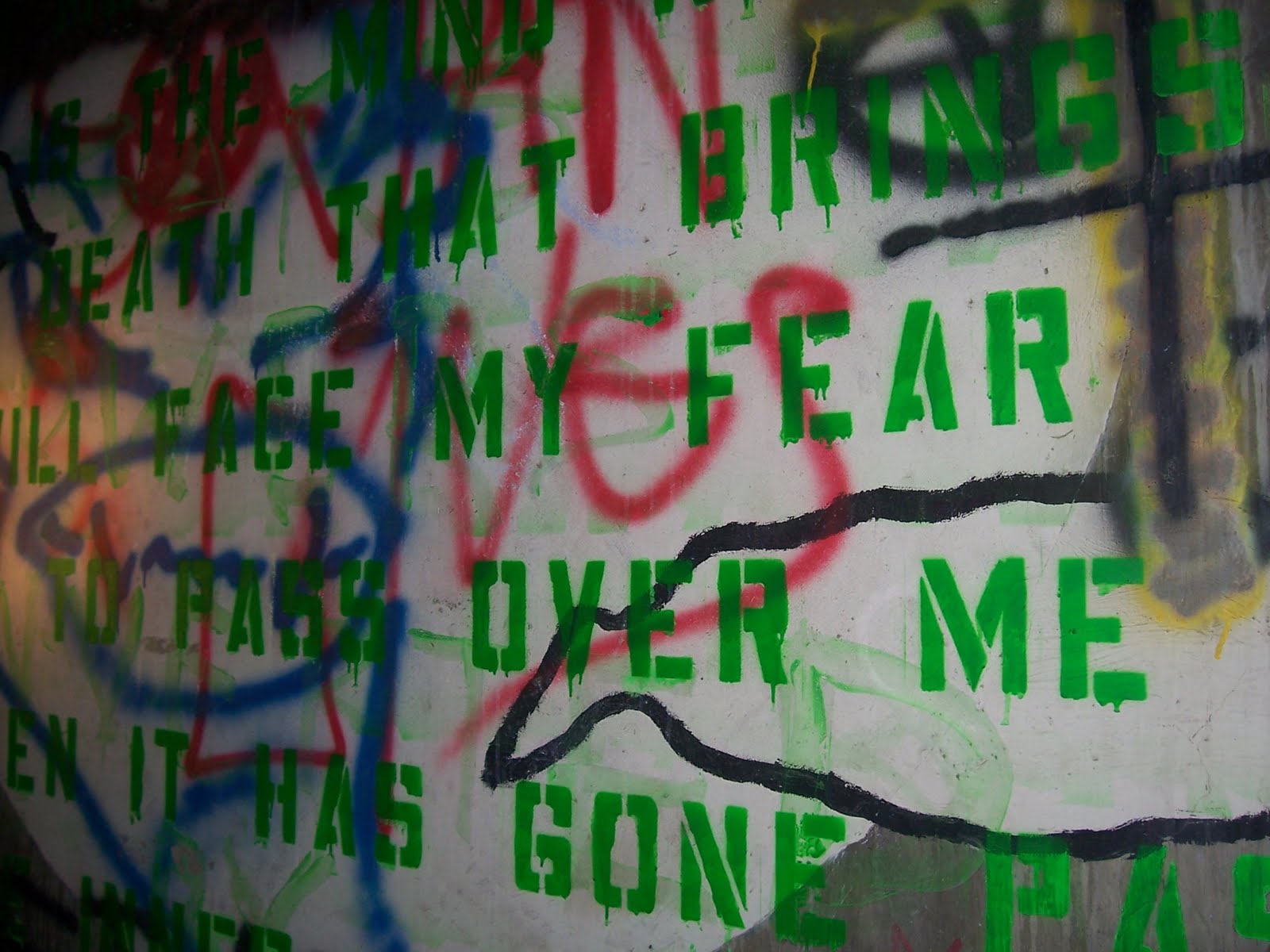
They draw paintings on the walls and write poems in many languages of the past and present time. They sign with their hand prints like their ancestors did on cave walls 30,000 years ago.


They perform rituals in dark passageways to prove their courage, running and screaming in dark tunnels, or to prove their cleverness, setting up complicated labyrinths of laser beams. The modern mind and the ancient mind find their meeting ground.


The pressure accumulated in the days of harsh challenges that constitute our modern initiation rites to the elite of the scientific world come to find their nocturnal release down the tangle of pipes in the hot and wet tunnels below the surface. The images and words on the walls tell stories not unlike those Ur-stories of the ancient caves. Bears and lions have been replaced by other monsters, by other fears, but the Underground remains the ritual place of descent, where fears are conquered by a creative act and where our human wholeness is finally restored.


The Underground is the place where life and death come face to face, the place for conquering fear, for gaining the strength of Resistance and endurance. A descent to the Underworld is a rite of passage: for Dante it was the crossing of that middle point of our life, for Odysseus and Aeneas the dialog with the shadows of the Underworld brought knowledge, in Eliot's "Waste Land" it is already our modern psychic Underworld, though still populated by the ancient Sybil and Tiresias. It is no coincidence that the entrance door to the Caltech Underground, in the basement of the undergraduate dorm, is inscribed with Dante's words, "Lasciate ogni speranza, o voi che entrate". It is the gateway to Dante's Inferno that opens the doors to the transformative experience that leads one on, eventually, to the discovery of worlds: conquering fear, facing the darkness without and within, just like our ancestors did, in the cave of the bears. We are modern and ancient, our mind is primitive and intellectual, and each needs the other for the alchemy of the creative process to take place. Science is a world of refined marvels and of cruel conflicts and we need an adequate language to express both.


The rites of passage, as the journeys to the Underworld, and deeply personal and yet they are shared experiences. They are transmitted on from one generation to the next. The art of painting on the cave walls in the early days of humanity was taught and learned and transmitted across the generations. The modern language of science is taught and learned and we hope to transmit it and preserve it across the encroaching obscurantism of the dark ages. Those who have already experienced their rite of passage also act as guides to the routes of the Underworld, like Dante's Virgil or Homer's Tiresias, who, without seeing, could see with the mind.


Another apt metaphor of our time for the journey to the Underworld is Tarkovsky's movie "Stalker", where the theme of the guide that offers a safe passage across the Waste Land and its obscure perils is expanded in its most profound and captivating form.


The premise is the story in the Strugatsky brothers' novel "Roadside picnic": amidst the destruction brought to "the Zone" by a encounter with an alien civilization, whether leftovers of a brief passage or accidental wreck, the "stalkers" guide people deep into the territory affected by frightening and incomprehensible phenomena. Its margins populated with mutated and traumatized people, its inaccessible interior scattered with strange artifacts, the zone is an Underworld of the nuclear age and the voyage described in "Stalker" a poetic retelling of the descent, of the facing of fear and death, and of ultimate transformation.

Friday, April 8, 2011

City Lights

Choose your enemies carefully, for they will define you.
Make them interesting, 'cause in some ways they will mind you.
They're not there in the beginning, but when your story ends,
they're gonna last with you longer than your friends.

(U2 - Cedars of Lebanon)

Physics conference standoff seemingly resolved. Los Angeles night: beer and Spinoza. The script Tariq Ali wrote for the theater play "The trials of Spinoza", later turned into a short documentary movie, gives a poignant portrait of a philosopher struggling for a defense of reason in a society crippled by superstition and in the grip of the religious wars that ravaged Europe in his time, and proposing a striking view of "the divine" that denied the supernatural of the personal god of traditional religions in favor of the immanent and natural marvel of an impersonal universe.


Up again at 4 am, heading to San Francisco, the last refuge of the troubled minds. First stop, Anarchist Bookfair, trying to get hold of the elusive small Anarchist publisher to whom I entrusted the manuscript of my first novel, dating back to other standoffs and other enemies ten years back. My recent trip back to the Ivy League environment that originally inspired it made me all the more aware of how good people are, some years down the line, at rewriting history. So I want all the more to have it out, that old crappy science fiction novel of mine, because at least that's a tangible record that history cannot be rewritten, just as my blog posts of these more recent years will prevent others, who are already trying to rewrite everything as if I had never existed, from attempting the same murky game. That old novel is not just a story of a dysfunctional scientific community in a distant but not so unrecognizable future. It is also a reflection on the difficult historic dialog between Communism and Anarchism throughout the tradition of the workers movement struggles, and that's why it ended up in the hands of my Anarchist comrades up in the Bay Area.


The plane flies low for an hour over the Californian coast: Santa Barbara, the islands, Big Sur, Monterey, the Bay: all this tragic beauty of landscape, this breath-taking marvel of mountains and reefs, is just a deep powerful scream of rock emerging from the depths of a moving Earth. Meanwhile, I read Gerald Raunig's "A thousand machines". As all the postmodernist writings, the book wanders around between loosely connected themes, all vaguely linked by the "machine" theme, first traced back to the treatment Marx gives both in the Grundrisse and in Das Kapital, and then jumping around between movies, psychoanalysis and philosophy, ancient texts, modern activism and all that. I generally don't much like this style, but this short book made for a good reading. Three of the themes touched upon seemed to resonate with me at this particular time: bicyles, the theater machines, and what the author calls the "war machines".

Regardless of the author's specific viewpoint and examples, bicycles are a statement of resistance: resistance to the imposition of motorization, a statement of personal courage and the strength to face up to coercion, the courage to say "No" to the car bullies and to a society that tries to silence dissent. The theater machines of ancient Greece, from which the word "machine" itself derives, the "deus ex machina" of the Latins, was the trick Euripides used to get his tragedies to some kind of resolution after a complete impasse had been reached in an impossibly complicated situation. From the theater machines of antiquity, the author moves on to those of modernity, especially to the Soviet avant-garde theater of the years immediately following the Russian Revolution, with its fragmentation of the bourgeois theater, its use of the Dadaist and Constructivist elements, the body-machines, the "Theater of Illusions". The "war machine" the author refers to is not, as one may at first think, the big apparatus of war maneuvered by the Nation States in their aggression tactics, but rather the small and spontaneous arising of strategies of anarchist resistance based on the micro-political, artistic-activist practices of intervention. In the words of the author, "the martial dimension of the war machine consists of the power of invention, in the capacity for change, in the creation of other worlds". The modest and unassuming nature of these assaults perpetually operated on a line of flight, nonetheless allow it to become an effective weapon that can carry out a siege of the seemingly impenetrable walls of power. In the words of the anonymous author who treated the war tactics of the barbarians challenging the suffocating rule of Rome, "machina multa minax minitatur maxima muris". My whole scientific work in the past three years has been a "war machine" in this specific sense.


San Francisco: N-Judah rolls its metal wheels and cranks its music of steel up the hills and down again towards the ocean. Off at Golden Gate Park, and there they are, black clothes, bicycles only (the Revolution will not be motorized), vegan food, and book stands, lots of them, on the floor outside and on the tables indoors, the whole archipelago of the radical anarchist publishing scene. I get hold of my publisher: yes, of course, my science fiction is not science fiction, that much I knew. It wasn't meant to be, otherwise I would have given it to a different kind of publisher. Alright, things seem to be moving forward anyway, in some direction, in the way you expect it to happen in the anarchist world: the spontaneous emergence of ordered structures and complexity from chaotic dynamical systems. That's the way Anarchy works.


Second stop, inevitably, City Lights Bookstore, the publisher of Howl and cradle of the Beat Generation. Two years ago, during my Berkeley months, when I was just beginning to understand how tragically misplaced my trust and friendship had been for so many years, I often ended up here, this side of the Bay, down in the basement of City Lights, where more than half a century ago Ginsberg gave his first public reading of Howl. Now things are different: I am no longer at the stage where I still have to recognize and accept what is happening. I am no longer shocked at anything, I am only fighting an endless and meaningless war of survival. So I can now come here again, with eyes that have become accustomed to looking upon the ugliness of personality cults and sickening ego complexes disfiguring the face of science. I can now finally sit on the stairs leading to the attic of City Lights, where the largest collection of the Beat literature is housed, and read slowly from Ginsberg's "Plutonian Ode".

Radioactive Nemesis were you there at the beginning
black Dumb tongueless unsmelling blast of Disillusion?
[...]
I chant your absolute Vanity. Yeah monster of Anger
birthed in fear O most
Ignorant matter ever created unnatural to Earth! Delusion
of metal empires!
Destroyers of lying Scientists! Devourer of covetous
Generals, Incinerator of Armies & Melter of Wars!
[...]
I dare your Reality, I challenge your very being! I
publish your cause and effect!
I turn the Wheel of Mind on your three hundred tons!
Your name enters mankind's ear! I embody your
ultimate powers!
My oratory advances on your vaunted Mystery! This
breath dispels your braggart fears! I sing your
form at last

(Allen Ginsberg - Plutonian Ode)


Berkeley in the afternoon: the small street market down Telegraph Avenue, selling psychedelic accessories, the sweet smell of pot in the air. I am here to deliver another general audience lecture on my scientific work at Revolution Books, the small alternative bookstore run by the Revolutionary Communist Party of America. I slowly go through my slides presentation on mathematics and cosmology. The audience asks very intelligent questions: for a non-scientifically trained public, this is the best you could hope for in terms of an audience that really cares about every word you say. I go out with the Party members for drinks after the talk, and some conversation. Lots of questions still about my talk, nice intelligent questions: people who care about learning science in every way they can. Then more talking, political. The historic seeds of distrust between Communists and Anarchists are all too painfully evident even today, even in this stronghold of the radical Left that is the Bay Area. "So, your novel is with the Anarchists? Oh, it's in good hands: they haven't lost it yet?" Come on, comrades, we did this mistake many times before. If Communists and Anarchists hadn't started fighting each other out in Barcelona, instead of putting their energies into fighting the Fascists, maybe we wouldn't have lost the Spanish Civil War, as Orwell so sharply and convincingly documents in his "Homage to Catalonia".


As usual in my life, I am caught in between two worlds, sharing too much of both to be partial to either. Communism is, down to its crude essence, about believing in the future - the Radiant Future. One thing you can count on with communists is that they will be ready to defend science with their lives, which is a rare quality in the increasingly obscurantist world of today. I would not have become a scientist, had it not been for the Communist Party back home, and the effort it made to help us get the good science books, pumping up the enthusiasm, helping the young generation see in science the key to a better future for humankind. Now, when I give these simple lectures here, for the restricted audience of the Berkeley Communists, just blocks away from the shiny big science of UC Berkeley, I see again the same enthusiasm, the same uncontaminated trust in the beauty and the revolutionary mission of science. I bask in the shining light of their untarnished optimism.


My optimism was murdered, leaving behind a dark phantasm. This is why, by now, I tend to consort more easily with the complex darkness of Anarchy than with the radiant sun of Socialism. The dialog on science with the anarchists is considerably more complex, for one thing, because a good number of them actually do have a science background. Many of the movers and shakers behind the Californian anarchist scene are trained in science and technology and belong to that vast area of cyberculture that emerged directly from the counterculture. They are the super-hackers, who live by day as software developers in the sunny silicon valley glamour of advanced technology and construct by night a network of resistance and insurgency. Some of them have turned viscerally anti-scientific, advocating various forms of green-anarchist neo-primitivism, not because they do not have enough knowledge of science, but because they have seen too much of the inner workings of the scientific community. That's what makes the discussion so complicated: I know what they know that I know about the structures of power enmeshed within the apparent beauty and purity of science. There is no optimism to appeal to there, no radiant future left to build, just an endless struggle of resistance: the war machine. They speak directly to what I have become.

Love wears down to bare truth
My heart hurt me much in youth
Now I hear my real heart beat
Strong and hollow thump of meat

(Allen Ginsberg - Lack love)

As in Tariq Ali's Spinoza script, I have learned what it is like to be excommunicated by the vanity of the official orthodoxy of this dusty corner of scientific paradigm, and yet I still long for that old socialist vision, for its untarnished optimism, for the absolute trust in the beauty of science. That's why I came, on my knees, to knock at the door of the Revolutionary Communist Party, asking them to allow me to talk to them once more about science, asking them for a share of their optimism, of the brightness of their radiant sun. Despite all the pain and disillusionment, I still believe that there is beauty in truth and truth in beauty and that science is the last remaining form of poetry in which we can still sing an ode to the universe.

Sunday, April 3, 2011

Mixing memory and desire

April is the cruellest month, breeding
lilacs out of the dead land, mixing
memory and desire, stirring
dull roots with spring rain.

(T.S.Eliot, The waste land)


Roman Polanski - Macbeth (Banquo's ghost)

Yes, it is conference season once again, that cruel season when the dead are being dug up from their shallow and restless graves. This year the choice is between the conferences I should have been invited to and was not because the Lord and Lady Macbeth do not like their banquets disturbed by bleeding ghosts, and those I was forced to turn down myself, because, after some time, even a ghost runs out of blood to smear more banquets with. So far I had kept only one last conference in the list, a small physics conference I had erroneously thought would be a safe space for me to go to, until I realized that even that last corner of existence is denied. I'll let that go as well: I am tired of this endless war, this endless bleeding out. Tired of perennially fighting back, with the last hope gone of a moment in a future history of the universe, a remote corner of space and time, where I may finally be at peace.


Roman Polanski - Macbeth (Banquo's ghost)

What are the roots that clutch, what branches grow
out of this stony rubbish? Son of man,
you cannot say, or guess, for you know only
a heap of broken images, where the sun beats,
and the dead tree gives no shelter, the cricket no relief,
and the dry stone no sound of water.

(T.S.Eliot, The waste land)

Where is the Birnam wood? Why comes it not? Or have the witches now deceiving words for us, the dead, as well as for the living? We, ghosts, will keep on fighting, will keep returning to haunt the Thane of Cawdor, because there is nothing else that keeps us afloat between this world and the night. When all is done and said, when all my blood is drained and all your talks are given, and the curtain falls once more upon this darkness, there will be left but a barren landscape of desolation, a scanty meal for the worms, and the same unspoken question: "What for?" Were your insatiable ambitions, your unrelenting egos, worth the destruction of friendship, trust, intellectual affinities, and ultimately human lives?


Roman Polanski - Macbeth (Birnam wood)

When fight is to life what ghosts are to shadows, when the swamps of memory harbor a decaying hostage conscience and desire, and blind windows stare upon a petrified world of nightmares -the burnt out desert that you casually and carelessly left behind you- all that survives is a long and meaningless wait for improbable signs of walking forests.


Roman Polanski - Macbeth (Banquo's ghost)

That corpse you planted last year in your garden,
has it begun to sprout? Will it bloom this year?
Or has the sudden frost disturbed its bed?
Oh keep the dog far hence, that's friend to men,
or with his nails he'll dig it up again!
You! hypocrite lecteur! - mon semblable, - mon frère!

(T.S.Eliot, The waste land)

Saturday, March 19, 2011

Of waves and particles


The devastating magnitude 9 earthquake with tsunami that hit the Northeast of Japan, and the unfolding nuclear crisis at the Fukuchima Daiichi power plant, is a human tragedy of immense proportions, and at the same time a powerful reminder of how limited our understanding of nature and our predictive power really is. It was long known that subduction zones can generate the most powerful earthquakes on the planet, but it was mistakenly assumed that only those corresponding to a younger oceanic crust (see the recent article on Nature) could reach the magnitude 9 level. An accurate (or more accurate) modeling of earthquakes determines our capacity to prepare and withstand the possibility of natural disasters, minimizing casualties: the Pacific coast of Northeastern Japan was perhaps the best prepared to face a tsunami (containment walls, escape routes, etc) yet not one with ten meters high waves.

The ongoing Japanese nuclear crisis is arguably the most transparently reported nuclear accident in history, yet how well is the technical information being transmitted to the general public? Is the accident really showing that nuclear reactors are inherently unsafe? There is a factual observation: the Fukushima reactors did not break down under a magnitude 9 earthquake, which is coming near the maximum intensity of earthquakes ever recorded on this planet: the reactor did switch off correctly. All through this crisis, the reactors had not been fissioning (another issue is to make sure that criticality, hence a new chain reaction in the fuel, is not ignited now, for example by the fires and overheating in the spent fuel ponds). It was the tsunami, not the earthquake that caused the most serious problems: while the facility had a tsunami wall, it did not stop a wave of that magnitude, which damaged the cooling system and started the overheating problems. So what does this mean? Are the reactors safe or unsafe? There is a meltdown happening: how bad will that be? In the last few days, there were a few sources of scant but reliable news (World Nuclear News, the International Atomic Energy Agency) and a lot of wild speculation by journalists with contradictory reports and little respect for technical reliability.


Finally, about a week after the earthquake and tsunami event, a very clear and detailed talk by nuclear physicist Benjamin Monreal, delivered at the Kavli Institute for Theoretical Physics in Santa Barbara, was made available as video with accompanying slides on the web. Why is this reporting so much better than anything that made it to the press? It is not a specialized talk for nuclear physics experts, but a presentation directed at a reasonably science-literate general public. It conveys precisely defined concepts, quantitatively meaningful notions of units of measures and their meaning, valuable and detailed comparisons with other situations of nuclear crisis (Three Mile Island, Chernobyl). Overall, what matters is the sense of conveying, as much as one possibly can in a potentially out of control and rapidly evolving situation, reliable and verifiable quantitatively stated and qualitatively unambiguous information. If one wants to strip it all down to the back bone, this is what science is about. Events like the ones being discussed bring to the forefront more forcefully than ever the sensitive issue of scientific literacy. We live in a world where things like nuclear energy and the functioning of nuclear reactors, plate tectonic and the likelihood of earthquakes, the complicated dynamics of nonlinear waves and tsunamis, as well as many other scientific issues involving medicine, energy, the environment, are or should be part of our daily preoccupations as informed citizens of the world.


The fascist current prime minister of a Southern European country delivered a highly embarrassing televised speech in which, while addressing the current situation in Japan, he revealed that he does not understand the difference between an atom and a cell and gave public display of several ridiculous misunderstandings of basic elementary school science. I wish I could ascribe this gross ignorance of science just to his being a fascist and a complete moron (at least he didn't try to claim that the Japanese earthquake was a communist conspiracy like he claims everything else in the world to be), but I am afraid that, unfortunately, not a few people who would recognize themselves with the political left would also, if pressed, sport an equally cavalier attitude towards scientific literacy. How comes? We may be all, at least those of us who are citizens of democratic or semi-democratic countries, be one day or another called to vote on issues like nuclear energy. Earthquake preparedness requires the investment of public funds: is it acceptable in Southern California to have nuclear reactors made to withstand intact a magnitude 7 earthquake? Because it is a logarithmic scale, the cost of upgrading from magnitude 7 to magnitude 9 escalates accordingly: is it needed? desirable? can one effectively evaluate the risk factor? Answering this question, in the positive or the negative, requires getting some technical knowledge: even that may well not be enough, as in the case of the present Japanese earthquake that defeated the known models of earthquake dynamics in subduction zones, but certainly gross misunderstandings can only make decisions worse.

The risk of criticality and of a chain reaction in spent fuel on fire in a nuclear facility may be faced effectively using the fact that the isotope 10 of the element boron is especially good at absorbing thermal neutrons and can be refined to near pure form out of the initial 20% occurrence in natural boron, and can be mixed, in the form of boric acid, with the reactor water based coolant. This type of intervention may or may not succeed in resolving the problem, depending on how serious the situation is. However, it is clear that the problem will not, by any means, be solved by some postmodernist mumbo-jumbo about different context-dependent truths and ontological relativism, not by invoking divine wrath (two faces of the same irrationalist coin). Like it or not, science is the only effective way humankind has ever had to face the uncertainties of the world and try to make reasonably informed decisions about it.

Let us then look more closely at some of the issues involved in the present crisis: how would a reasonably scientifically literate person go about getting some more specific information on the matters at hand? To define my terms let us say that, by "scientifically literate" I mean someone who would not run screaming at the sight of something that requires some basic calculus to understand. I will argue later on why in the world of today one should aim at this level of understanding of science at least, for a democratically engaged and informed population.


Earthquake and tsunami first: in the wake of the 2006 tsunami, a couple of quality books were published, which survey the present understanding and models of nonlinear waves and tsunami phenomena. Two volumes of this type that I (as a non-expert) am aware of are "Tsunami and nonlinear waves" by Anjan Kundu, and "Physics of tsunamis" by Boris Levin and Mikhail Nosov, the latter coming out of the Russian school of fluid dynamics.


The interested reader who may be willing to take a closer look at this kind of literature, however, will immediately encounter one of the most obvious obstacles in increasing general literacy on scientific topics of wider societal impact: scientific literature ain't cheap! Each of the two volumes mentioned above sells at around $150, used or new. If you are an even more mathematically inclined reader, you may in fact be luckier, and get away with "just" around $60 for "Tsunamis and hurricanes: a mathematical approach" by Ferdinand Cap. You are similarly "lucky" if you decide that you don't really care about the dynamics of anomalous waves and you only want to get a good idea of plate tectonics. In that case you may for instance get, again for around $70 bucks, a book like "Plate tectonics" by Wolfgang Frisch, Martin Meschede, and Ronald Blakey.


I am not suggesting that you should run off to your nearest bookstore or jump on your favorite web browser and online store and get hold of these expensive books if you want to read something about how tsunamis and earthquakes actually happen. Fortunately, most of us have a less expensive alternative to buying science books, which is to walk over to the nearest university library and hope that, if not the exact title you're looking for, they would have something along those lines you can browse and read (though probably not borrow if you don't have a university affiliation). However, how likely is that to happen? How often do people actually go and look for technical literature at a university library when they want to know more about some piece of news involving natural phenomena? I can only guess, not having any data or statistics available, but I am doubtful that this would be a frequent occurrence.

What I am trying to argue here is that the out-of-control prices of technical and scientific literature and the monopoly that a few publishing houses have on the market of specialized scientific literature is one of the factors that contribute to hinder wider dissemination of science. Given the generally prohibitive prices of good scientific literature, all people are left with is the cheaper alternative of popular science, which is generally a low quality product, full of inaccuracies if not outright misconceptions. Part of the unfulfilled dreams of socialists and communist visions of the future of humankind was to achieve a widespread high level of scientific literacy all over the population (see Yefremov's "Andromeda" for a powerful literary representation of that dream in a science-fictional context). This ideal at least brought about the existence, in those days in the Eastern European block, of a broad range of easily accessible, low cost, high-quality scientific publications, at all levels of specialization. The trickling of many of those books across the Iron Curtain made it possible for many of us who grew up in Western Europe to achieve a degree of scientific literacy that would have otherwise remained inaccessible. If any of the books mentioned above would cost between 5 and 15 dollars instead of costing between 60 and 150, it would be reasonable to imagine that a reasonably scientifically literate person, who's had a minimum amount of calculus level education in science, may be willing to invest the time and mental energy needed to read at least the more accessible parts of a real scientific book on a topic close to immediate real-world events. Subsidizing the cost of scientific publishing would perhaps be one of the best investments towards increasing the rate of scientific literacy.

Let me comment briefly on the "calculus level" remark I made above. The capacity to understand what a derivative, an integral, or a differential equation mean is a fundamental and basic skill that allows people to make sense of systems evolving in time, rate of change, averages, conservation properties: all concept that are absolutely necessary in order to make any kind of quantitative prediction about the future behavior of a simple or complex system on the basis of data available at a given time. This is three hundred year old science, which was once the frontier of human understanding (at the time of Newton and Leibniz) but is now so well understood that it can be routinely taught to any high school kid. So it is not an unreasonable pretense to expect that the scientific literacy level of a well informed population of a democratic country should start out from what one may call the "calculus level" and grow from there towards more advanced topics, cultivating the capacity of people to routinely access and read scientific text (real ones, not crappy popularization!). People should not be puzzled at why one should put water in a nuclear reactor or on what boron is and what it has to do with it; they need not wonder on whether the lunar perigee represents a danger, or on what is or is not an issue worthy of attention. Scientific information is available of course: there is now plenty of information online which is not restricted to subscribers: scientific journals are sadly under control of the same publishing monopolies that impose on them far more outrageous prices than for books, but freely available preprints abound and more and more lectures by scientists are freely available as videos, as in the case of the beautiful lecture by Benjamin Monreal on the Fukushima reactor mentioned above. The problem with this type of online information is that it is often difficult for the non-specialized public to be able to locate and pick up the real scientific information in the middle of the veritable deluge of crap and pseudoscience of which the web is routinely inundated. This calls for some intervention on the side of scientists, in finding ways of making repositories of reliable scientific information online clearly visible and accessible to internet users that do not naturally gravitate around the academic sources of information. How to create "pointers" that can effectively guide people towards serious science resources is an important issue, probably one of the most pressing in the current social implications of science and science literacy.

Tuesday, September 21, 2010

The riddle of the anarchist watermelon


The anarchist movement is, by its own definition, an extremely composite and heterogeneous entity. Still, one can trace certain broad currents as they developed and differentiated along its roughly two century old history. Some political analysis and historians of the workers movement then like to talk of "Anarcho-communism", "Anarcho-syndacalism", "Anarcho-primitivism", "Anarcho-feminism", and the like. A coarser, and possibly more fundamental, distinction can be made between "green" and "red" anarchism, which essentially separated between those anarchist movements that put their emphasis, in many different ways, around ecologism and environmentalism, and those who view their roots and their ideology as more closely tied with the history of the socialist and (some versions of) communist ideology. Separating these two tendencies out does not do justice to the complexity of the anarchist archipelago, naturally, where often these components coexist and combine in intricate patterns. However, a distinction clearly exists and it is so deeply rooted as to have brought about the existence of a separate anarchist flag, with the same black diagonal half, but with the red one replaced, naturally, by a green area.


An old saying in my country of birth has it that the environmentalist movement is like a watermelon: green on the outside, red on the inside, and everywhere spotted with the black seeds of anarchy.


My sympathy naturally goes primarily to the "Red Anarchy" variant, that which is more closely tied up in its history to the workers movement, the socialist and communist tradition, and the industrial society. Abandoning industrial society not only does not seem in any way feasible but also not in the least attractive. We do live in an advanced technological world and our way of confronting society and our dreams of transforming it must be measured against the fact that technology is going to play an increasingly prominent role in the lives of people all over the globe. What we can and we must try to influence is how the interaction of human beings and technology does and will take place, not if. But at heart I am a communist and communism is a creature born of technological society and forever entangled with its destiny.

I am also a scientist, and as such I am especially concerned about the attitude towards science that the various forms of anarchist thought have taken.


If we take a step back to the early history of the anarchist movement and ideology, we find a very interesting text, written in 1903 by "the Anarchist Prince" Pyotr Alexeyevich Kropotkin, called "Modern science and Anarchism". It was written at the turn of the century, when in fact science had just started on the way of the great revolutions of quantum theory and relativity, which, however had not yet percolated down to the general public. So the "modern science" talked about in the text is eminently the mid to late 19th century science of thermodynamics and electromagnetism, the science that seemed to promise a nearly complete and entirely deterministic vision of the world. Imminent change of paradigm notwithstanding, the main point of Kropotkin is to reiterate the pledge of alliance to science of the anarchist thought. Kropotkin identifies the scientific method of inquiry used in the physical sciences as superior to the "dialectic materialism" approach favored by the orthodox marxists, which he sees as marred in preconceived ideas derived from idealistic philosophy and never realistically tested for effectiveness. Science works, science gives us a reliable way of looking at the world, of making predictions and testing them against data and facts. Kropotkin advocates an anarcho-communist thought based upon the results and the methods of the hard sciences, and subject to adjusting its ideology to the results of scientific inquiry, modifying what is proved wrong and confirming what stands the test of scientific inquiry. He admits, naturally, that when it comes to the realm of the social sciences it is difficult to apply the same level of rigor of the deductive scientific method as one can maintain in the hard physical sciences, but in his mind the goal is to model the social sciences on the hard sciences, and in that way eliminate the element of prejudice based on the tacit unquestioned assumption of a class based society that marred the general viewpoint on issues involving economics, social studies and similar disciplines. Within a few years of his writing, it became clear to everyone that even the hard sciences themselves where much more intrinsically complex in their view of the world than the late 19th century triumphs of physics appeared to imply and the new wonderful triumphs of 20th century physics opened the door to a fascinating view of modern science, but one less prone to adapt to dreams of reductionism. Nonetheless, the main point of Kropotkin certainly stands the test of time: that progressive political ideology stands hand in hand with scientific progress and scientific thought. This would seem to be an unshakable pillar of our philosophical history. And so it was, for quite a long stretch of time across the 20th century.

Enter postmodernism. Much of the theoretical foundations of left wing ideology was swept away by the postmodernist wave of the eighties: a flood of "soft thought" and aggressive relativism that started to look at science as an enemy instead of an ally. One can understand historically how some of the hostility against science grew out of well grounded concerns over its role in the service of the military-industrial complex, in decades of Cold War, and an equally justified concern over the looming specter of an environmental catastrophe, caused by an accelerated industrial development that seemed to care little for sustainability and preservation of the natural resources. In addition to these valid concerns there was another perfectly well justified reason for criticizing the sociological makeup of the scientific community, which appeared to be excluding from its ranks certain groups of population like women and ethnic minorities. However, the response to all these reasonable concerns was completely unreasonable and it had the overall effect of severely damaging leftist ideology and completely undermining many of its major achievement, gained as a result of long and painful struggles across the history of the 19th and 20th century.

Let's be more specific: the postmodernist "left" accuses science of being intrinsically a patriarchal construct of male domination, a discourse with no intrinsic validity other than the task of perpetuating its prejudices and suppressing other forms of thought, which are equally valid but more intrinsically feminine and based on essentially unverifiable systems of primitivistic beliefs. This type of claim essentially destroys completely two centuries of had won achievements of the feminist and women liberation movement, which struggled precisely against this type of idiotic prejudice according to which there is a male thought and a female thought and that rational thinking is the exclusive property of the first and the latter is relegated to the domain of wishy-whasy nonsense. Try as you may to flip the coin around and pretend that rational thought is bad and wishy-washy nonsense is all we should be aiming for (which is a completely moronic point of view, contrary to anything we, as progressive left-wing people had always believed in), you will still be left with the same discriminatory association of one type of thought to men and one to women. How on earth did anyone manage to brainwash people into believing that a point of view of this sort could be called progressive?

One of the basic tenants of socialist (and with it anarchist and communist) ideology was always defending reason against superstition. We traditionally opposed organized religions because they used supernatural beliefs to subjugate people, in the service of the ruling class. We opposed them because they prevent people from thinking rationally about causes and effects, we opposed them because they opposed science. Yet, the postmodernist "left" has no hesitation in supporting all types of nonsensical superstitions, from New Age baloney to astrological crap, to a revival of witchcraft and magical thinking. Who is calling this "the left"? Why? How did anyone manage to propagate the idea that promoting superstition against rationality is anything we would accept to call progressive?

I am sorry neo-primitivist, nature seeking, horoscope reading green anarchists, my dear comrades, I stand by our red flag of progress and reason!

I submit that one of our greatest struggles today is to regain science, to claim it back as our own! We live in a technological world where all the more those who control science control the world. If we choose to turn our back to science, we will be simply accomplishing a self fulfilling prophecy, leaving behind us a scientific community that will become all the more conservative, male dominated, in the service of the capitalist system of exploitation and tied up to the military apparatus. It need not be so, however, for if we claim science as our own, as it always was in the history of our ideology, we can turn the tide towards a scientific community that is inclusive, conscious of the needs of the environment (and with the knowledge needed to actually do something about it), that helps

Already, fortunately, despite the twisted portrait that the postmodernist "left" (which has never actually seen a real scientist in close quarters) tries to depict, the scientific community is already generally very left-wing and progressive, and if we (the left) don't screw that up, it will continue to be so in times to come. The underrepresentation of certain groups is still real and worrisome, but not due to an intrinsic nature of science itself, but to the residual existence of an order of things in our society at large (not in the scientific community itself) that creates impediments to its enlargement and broader inclusiveness. It is the traditional society we must fight, with the help of science, not the other way around. One should also point out that the postmodernist attitude of the "left" itself contributed to making the scientific community even more unbalanced in terms of its composition, thus perpetuating the exact same prejudices it should supposedly be fighting against.

Anarchists, communists, socialists, let's reclaim science as our own mode of thought as Kropotkin advocated. Let's return to that progressive rational view of humankind our long struggle for a society of equality and justice was always based upon.

Monday, June 21, 2010

The ashes of memory

In the late spring of 1945, a group of resistance fighters watch the Brenner Pass, hidden in the forest, on the steep mountain range dividing occupied Northern Italy from annexed Austria. A long column of military convoys is heading north: a defeated army on the run, a heavy march of infantry, armored vehicles, artillery. A human mass in disarray, the tentacles of conquer hastily retreating, the invincible army that terrorized Europe finally crushed. Hour after hour, they watch the German army go by, the mass of tired soldiers, the acrid smell of defeat, the metal rattling of tanks, the shouting. They watch for an endless time, until the human river begins to dry out. Fewer soldiers now pass and the noise dies out in a shower of faint echoes bouncing around the mountain tops. It is cold at this altitude in the Alps, even that late into the spring. Silence. The partisans keep watch. The Brenner Pass is empty and silent, as if all that immense retreat had been but a passing dream in the much larger river of history. Then silence is broken once more. A single military vehicle advances on the same road. A different color, a different flag. American. The end of World War II.


One of those partisans was my father. He was fifteen at the time. During those five years of war he saw the sealed trains heading slowly north along that same route, that cut through the majestic wall of dolomitic rock. The trains carrying their human cargo to the furnaces of Birkenau. They fought a guerrilla war, barely more than children at the time, against the most powerful and technologically advanced army of Europe. They fought in the name of that Socialist future they were hoping to create... "to conquer our red spring, where the sun of our radiant future rises". Songs, memories, words transmitted and repeated. My father passed away some ten days ago. With his ashes we bury a part of our memories, of our connection to the defining moments of European history.

Memory is the most precious possession of human civilization. We keep historical records, we create literature and art, to the purpose of maintaining a link to our collective and individual past, preserving human history near and far, recording, whenever possible, not only the facts, but a sense of the feelings that went with them. Memory fades away slowly, until it passes suddenly into nothingness, in that transition of substance from alive to inanimate. What stays behind are not the improbable afterlives depicted by religions, but the gestures that enriched the lives of others, and a few scattered thoughts, collected in writings and in whatever other forms of artistic expression we leave behind when we depart. Ultimately, all human acts are transitive and impermanent, but the larger texture of history, to which they all contribute their part of the thread, grows on and transforms.

There will be still, one day, young guerrilla fighters watching powerful invading armies from the mountaintops. They will not be the same men and women who fought the resistance war against the Nazi back in 1945, as my parents did. Whoever and wherever they will be, they will share similar songs and similar thoughts, and will pass on their memories to their next generation. Meanwhile, we, the descendants of those partisans, who knew the postwar Europe they helped to create, will continue their fight in whichever way our time permits.

... Con lo stesso impegno che si chiama, ora e sempre, Resistenza
(Piero Calamandrei)

Thursday, June 3, 2010

The filth and the fury


I saw the best minds of my generation destroyed by madness, starving hysterical naked ...
(Allen Ginsberg - Howl)


In the academic year 2007-2008 I used to work for a research institute in Germany, trying to take care of eight graduate students, along with my own research, which was just about to hit full speed against a wall (of which too much has already been said in this blog). That was the time when I first reached that breaking point I have by now permanently sunk into. I owe madness in equal parts to my former friends and collaborators of many years (enough said on that) and the other half to the German University.
Here comes their share!


... who passed through universities with radiant cool eyes hallucinating Arkansas and Blake-light tragedy among scholars of war, who were expelled from the academies for crazy & publishing obscene odes on the windows of the skull ...


If you've never fallen through the rabbit hole into the world of Alice in Wonderland, and you've never really seen what absurd means, you should take a quick tour of the graduation procedure for students of the German University. Here's a quick comparative anthropological analysis of the same procedure in the Californian Institute and in the German University. Student A is a graduate student of, say, mathematics, in the Californian Institute, while student B is also a graduate student in the same subject, and with the same supervisor, but in the German University.


... with dreams, with drugs, with waking nightmares ...


Around October-November of the year X, both students, having nearly completed their PhD thesis, apply for postdoctoral jobs. Typically a postdoctoral job that starts in July, August, or September of the year X+1 is advertised in the fall of the year X, with a deadline usually around December. Offers are made out during the spring of the year X+1. Since students typically defend their PhD thesis around May or June of the year X+1, the offers come a few months before graduation. At the time when offers are made and the student signs the job contract, the student's advisor more or less formally guarantees to the postdoctoral employer that the student will defend the thesis and complete the PhD by the starting date of the postdoctoral job. Should the student not finish by the established date, not only the student risk losing the job, but, since postdoctoral jobs in mathematics typically come with teaching duties, the employers will find themselves with a missing instructor and classes that need to be covered and with the enormous difficulty of finding a last minute replacement. Thus, for the whole system of postdoctoral jobs to function smoothly, it is necessary that the assurance the PhD supervisor gives at the time when job offers are made out, that the student will graduate in time, is considered reliable and dependable. PhD supervisors put their reputation on the line when they give assurance to postdoctoral employer regarding the predicted graduation dates of their students.


... who wandered around and around at midnight in the railroad yard wondering where to go, and went, leaving no broken hearts ...


Coming back to student A and student B, they both go through the job application procedure and both secure a good postdoctoral employment, for which their supervisor promises that graduation will take place in time. What does graduation consist of? Well, to begin with, the final manuscript of the PhD thesis has to be submitted to the appropriate office of the university. This is what is required:

- Items required in order to submit a PhD thesis to the Californian Institute:

(1) - The electronic file of the PhD thesis.

- Items required in order to submit a PhD thesis to the German University:

(1)- Five typed and printed copies of the PhD thesis, including a CV of the student, signed by the PhD supervisor.

(2)- A separate copy of the student's CV.

(3)- A notarized copy of the student's passport and birth certificate.

(4)- Five copies of any published paper authored by the student, related to the thesis content.

(5)- A police clearance report.

(6)- A signed application formula with one passport photograph.

(7)- A separate abstract of the thesis.

(8)- Official proof of enrollment for two terms at the German University...

and so on.

Assuming that student B can promptly and timely produce all these documents and takes no more time than student A to submit the thesis, we come to the next step.


... who howled on their knees in the subway and were dragged off the roof waving genitals and manuscripts ...


After the thesis is submitted one needs a thesis committee.

- In the Californian Institute a thesis committee consists of at least four faculty members:

(1)- Any of the Institute faculty including postdocs can serve on the committee.

(2)-The committee can be formed, its members changed or new members added at any time until the moment when the thesis defense takes place.

(3)- The only thing thesis committee members have to do is be present at the student's talk on the days of the thesis defense.

(4)-Only one week of time is needed between thesis submission and thesis defense.

- In the German University the thesis committee consists of four faculty members with the following regulations:

(1)- The first member of the committee is the thesis supervisor who has to write a thesis report, and give a numerical grade to the thesis.

(2)- The second member of the committee has to be a permanent professor in the Pure Mathematics Department of the German University. There are only six or so of those and if all of them say no, everything stalls.

(3)- The second member of the committee also has to read the thesis, write a report, and assign a numerical grade.

(4)- If the numerical grade of the second member differs from that of the first member the graduation SIMPLY CANNOT PROCEED, until the committee reconvenes and agrees on a common grade.

(5)- The third and fourth member of the committee have to be permanent professors in the Applied Mathematics and Physics Departments of the German University, respectively. Again, if all the eligible candidates decline, the graduation cannot take place.

(6)- The appointed third and fourth members of the committee have to read the thesis and the reports of the first two members and transmit their approval to the university.

(7)- A period of FOUR WEEKS has to pass between the time when both reviews (with matching grades) AND the approvals of the remaining two members of the thesis committee are transmitted to the university and the time when the actual thesis defense talk can take place.


... who demanded sanity trials accusing the radio of hypnotism & were left with their insanity & their hands & a hung jury ...


Student A at the Californian Institute goes through the process of submitting the thesis, appointing the thesis committee, scheduling the thesis defense talk and completing his thesis defense in less than ten days, with no foreseeable obstacle and with no need of any particular intervention from the PhD supervisor. Here is, instead, what typically happens to student B at the German university. (I say typically because, in the period between 2006, when my first PhD student graduated from the German University, up until now the experience I am about to describe happened NINE TIMES.)


... who created great suicidal dramas on the apartment cliff-banks oh the Hudson under the wartime blue floodlight of the moon & their heads shall be crowned with laurel in oblivion ...


After having submitted the thesis well ahead of the graduation deadline agreed with the postdoctoral employer, student B goes through the list of all the faculty members of the German University eligible to be second member of the thesis committee, showing them the thesis and the thesis report written by the advisor and already submitted to the university. All of the eligible members say NO, on the ground that they have better things to do. (Being in a thesis committee evidently does not seem to be a normal part of their academic duties: one wonders whether they apply the same conscientious attitude to, say, their teaching duties.) At that point the process stalls. Time passes and the graduation deadline approaches. The advisor intervenes and begins to contact the faculty members, begging, threatening, teasing, shouting, until someone agrees to be the second member and write the second report. Time keeps passing and the second report does not materialize. Again the advisor sends several reminders, pointing out clearly the fact that the student will lose the postdoctoral job if not graduating in time by the agreed date. Finally, after a humiliating process of many requests in increasingly desperate tone, the second report is submitted to the university. Time passes and nothing happens. A few days later, when inquiring on why things are not moving forward, the advisor finds out that there is a discrepancy between the grades assigned to the thesis in the two reports. Typically, the second report intentionally gives a grade that is about one decimal point below the grade assigned by the supervisor, so as to be sure to stall everything. A long discussion begins between the supervisor and the second referee, until an agreement is reached on a common grade. Meantime several more days have passed. At this point, with the thesis and both reports, student B starts to go through the list of all the eligible faculty of the German University who can be third and fourth member of the committee. Once again the same pathetic scene repeats itself, with people refusing to be on the committee, or formally accepting and then not sending in their reports. Time passes and the agreed graduation date approaches even more. When finally, after repeated interventions from the supervisor resulting in very stressful confrontations with the faculty members of the German University, all the members of the thesis committee have been appointed and the reports and approvals have all been transmitted to the university, one STILL NEEDS TO WAIT FOUR WEEKS before the thesis defense can finally take place! SEVEN TIMES over the past years this process resulted in the student being able to defend AT THE VERY LAST POSSIBLE MOMENT BEFORE LOSING THE JOB! Each time, this was possible only at the cost of an immense amount of stress on both the student and the supervisor. The remaining two cases of student-B-type experience are still ongoing.


... with the absolute heart of the poem of life butchered out of their own bodies good to eat a thousand years.


Of course, someone may ask at this point, yes but why, knowing that the graduation procedure is so hazardous and unpredictable, the students don't submit their thesis several months ahead of the graduation? After all, at the time when they apply for jobs they already have the results of their thesis, and one can surely speed up the writing process to leave a safe margin of time before graduation. Ah, no! Because the German University has thought of this possibility as well, and they included an additional regulation stating that, if the thesis defense does not take place within three months of the time of the thesis submission, then THE THESIS EXPIRES! This is a very interesting concept in itself: the idea of scientific results that are no longer valid after a period of three months challenges even the most relativist of postmodern philosophers. In other words, the graduation procedure of the German University has been explicitly and carefully designed to be a no-win situation and a byzantine maze with no exit route.


Ground where mere survival
requires
a desperate struggle,
where without
a desperate struggle
we perish,
that is
Death ground.

(Sun-Tsu, The Art of War)

In the fall of 2007 I realized that I was breaking down completely, partly due to the traumatic experience of having to ram several PhD students through the graduation procedure of the German University and partly due to the stress of trying to take care of one of the students who suffered from a severe psychiatric condition, for which the German University (unlike its overseas counterparts) provides no support structures (psychological counseling, student health insurance covering psychiatric care), so that the full burden falls entirely on the advisor's shoulders to do damage control and try to prevent the worst from happening. So I decided to escape and seek refuge in the Californian Institute. I thought I managed to escape barely in time to avoid a major collapse and breakdown. Unfortunately, precisely at that time my dear former friends and collaborators decided to deliver their blow and, even more unfortunately, the ghosts of the past came back and the remaining students who still need to finish their PhD with the German University forced me to a continued exposure to the same impossible nightmares, magnified by the additional difficulties of dealing with them at a distance.

On death ground,
fight.

(Sun-Tsu, The Art of War)


Postscriptum: When it comes to the point where a student, after finishing his PhD thesis two months ahead of the deadline required by his postdoctoral employer, faced with the impossible task of getting it through the graduation procedure of the fucked up German University in time not to lose his job, is brought to the point of attempting to take his own life, the grotesque obtuse stupidity of the German bureaucratic establishment acquires much more monstrous proportions, and begins to echo of that same stench of rotten authoritarian fascism that has been lingering on everywhere in its academic establishment. When it comes to the point where, knowing that the student in question is still in critical conditions in hospital, and nonetheless asks to be allowed to complete his thesis defense by a videoconference link (which would be a completely standard procedure in any overseas university), the dean of the German University does not even bother to speak in person to the head of the thesis committee who is asking for the official permission to proceed with the thesis defense by videoconferencing, and finally refuses to proceed on the ground of "maintaining their standards", then the medieval barbaric and idiotic procedure devised for the promotion of graduate students begins to stink of that same horrid stench of the rotting corpse of fascism that permeates the environment of German Universities... and someone had the guts to call this sewer a "center of excellence"?